
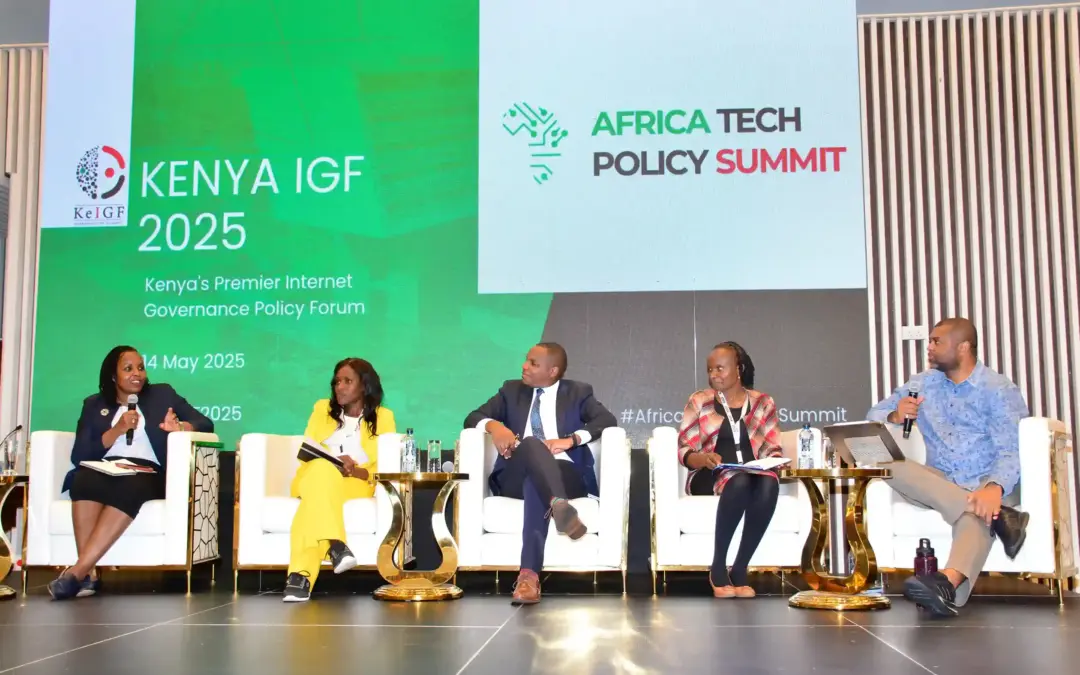
At the Africa Tech Policy Summit 2025, the Kenya Internet Governance Forum (IGF) hosted a dynamic fireside chat on “Responsible AI & Emerging Technology: Aligning Innovation with Ethics, Equity, and Economic Growth.“
Moderated by Ali Hussein, Chairman of KICTANet, the panel featured Joe Kanyua (Head of Digital Transformation, Safaricom), Immaculate Kassait (Data Protection Commissioner, ODPC), Dr. Esther Khakata (Strathmore University), and Liz Orembo (KICTANet).
The discussion explored how AI, quantum computing, and IoT can drive economic growth in Kenya while addressing ethical challenges and infrastructure gaps.
Key Insights on Responsible AI
Kassait emphasised the need for robust data and AI governance to build trust and prevent misuse. She highlighted the ODPC’s facilitative approach, debunking perceptions that it hinders business.
Kassait noted, “Data governance is not a deterrent but a framework to ensure trust, asking how intrusive data collection is.”
She pointed to synthetic data as a privacy-respecting solution for AI training and stressed the need for a designated AI regulatory body, citing capacity gaps and limited public awareness as challenges.
Kanyua framed digital transformation as “intelligently connecting people, things, businesses, and government.”
He underscored the critical role of infrastructure—energy, data centres, and chips—in positioning Kenya for the AI race. Kanyua warned, “Without a reliable electricity grid or data centres, discussing AI is futile.”
He highlighted Safaricom’s new Limuru data centre and urged investment in local chip development to avoid reliance on costly foreign solutions.
Dr Khakata advocated for embracing AI in education, rejecting bans in favour of responsible use. She shared how Strathmore University integrates AI into curricula, encouraging students to leverage it for efficiency while maintaining critical thinking.
Khakata showcased projects, such as IoT-driven farming solutions and AI for neonatal mortality predictions, but lamented funding shortages. “We have innovative solutions, but who ends up with the funding?” she asked, urging investment in local startups.
Orembo stressed the multistakeholder IGF model to ensure ethical AI governance. She highlighted AI’s social impact, citing Gen Z’s use of AI tools like ChatGPT to analyse policies and fuel campaigns, such as the #StopTheFinanceBill movement.
Orembo called for democratising data access for the public good, noting, “AI isn’t just for business; it’s for building democracies.”
She emphasized inclusive participation to address Africa’s diverse needs, warning that global AI dominance could marginalise the continent.
Audience Contributions and Global Context
Audience members enriched the dialogue. Robert Ford from Rwanda highlighted the global AI arms race, noting that military AI outpaces agricultural AI due to funding priorities. He urged Africa to define its AI agenda, citing Rwanda’s drone delivery success.
Ms Winnie Kamau discussed a startup developing AI for indigenous languages like Kinyarwanda and Maasai, emphasizing Africa’s innovation potential.
Another attendee, Conrad Keya, warned against Africa’s passive stance in the global AI race, risking dependency on foreign platforms.
Hussein referenced a paper, Situational Awareness: The Decade Ahead, warning of an AI-driven geopolitical shift. By 2026, artificial general intelligence (AGI)—capable of human-level reasoning—could outpace graduates, potentially escalating global tensions.
The panel acknowledged this as an, “AI arms race,” with Kanyua noting Saudi Arabia’s $600 billion data centre investments as a model for Kenya.
Challenges and Opportunities
The panel identified key challenges: unreliable power grids, limited data centre infrastructure, and insufficient AI education.
Kassait proposed regulatory sandboxes to test AI responsibly, while Khakata called for a mindset shift from land investments to tech startups.
Orembo advocated for data literacy to empower citizens, and Kanyua emphasized collaboration, stating, “Tech for good solves real societal problems—hunger, fraud, healthcare.”
Conclusion
The Kenya IGF 2025 underscored the urgency of aligning AI and emerging technologies with ethics and equity.
While Kenya boasts digital adoption, with 90% of citizens generating data, the panel stressed addressing basics—power, funding, and education—to avoid being mere “data inputters” in the global AI race.
As Hussein concluded, quoting Amara’s Law, “We overestimate technology’s short-term impact but underestimate its long-term potential.” Kenya must act now to shape an inclusive, impactful AI future.