
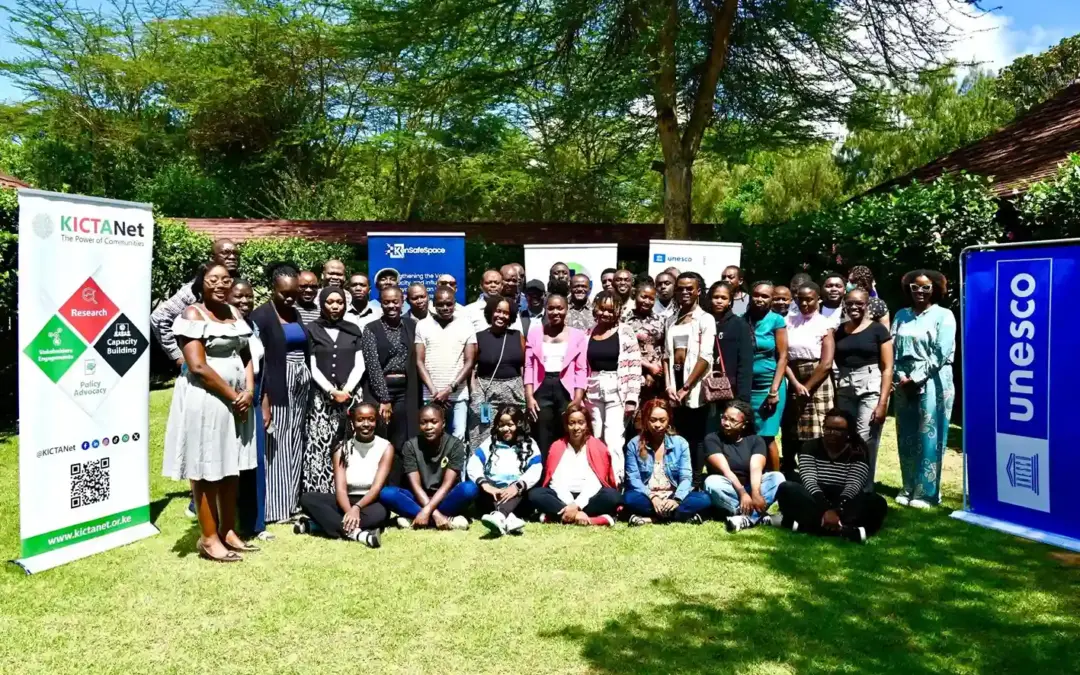
A three-day workshop on digital safety and governance, hosted by Internews, KICTANet, and UNESCO from May 7–9, 2025, in Naivasha, brought together 50 stakeholders from the Social Media 4 Peace (SM4P Phase II) and KenSafeSpace networks.
The event focused on strengthening digital safety, freedom of expression, and the governance of online platforms amid Kenya’s rapidly evolving digital landscape.
The workshop aimed to:
- Build stakeholder knowledge on digital safety, content moderation, freedom of expression, and platform governance, with special attention to protecting vulnerable and marginalized groups.
- Raise awareness of regulatory challenges in balancing online freedom of expression with human rights and democratic values.
- Enhance capacity to address cyber threats, misinformation, hate speech, and related online harms.
- Promote stakeholder participation in national and regional digital governance dialogues.
- Strengthen resilience and collaboration among digital rights actors.
Emerging Technologies and Regulatory Gaps
Participants examined the impact of new technologies such as AI, generative AI, green tech, 5G/6G, and blockchain. Concerns included:
- Bias and opaque governance in AI systems.
- Privacy, consent, and platform accountability in communication technologies.
- Data sovereignty risks due to reliance on foreign cloud servers.
- Gaps in Kenya’s legal and regulatory frameworks, with laws lagging behind technological advances. It was noted that “technology’s rapid advancement is outpacing regulatory frameworks.”
- Challenges in prosecuting cross-border digital crimes and accepting digital evidence in courts, highlighting that “Kenya’s legal and justice systems often lack the technical skills and resources to effectively tackle digital crimes.”
Online Harms and Content Moderation
The spread of disinformation, hate speech, and targeted online attacks—especially during major events like the June 2024 protests—was highlighted as a growing threat.
Gender-based violence online (TFGBV), particularly in local languages, was noted to “often go unmoderated and unreported.” This pointed to “the broader issue of cultural and linguistic sensitivity in digital governance and content moderation.”
The rise of “self-journalists” and low digital literacy were linked to the proliferation of misinformation.
Participants called for improved content moderation, transparency, and platform accountability, emphasising the need for remedies that balance freedom of expression with protection from harm.
Privacy and Data Protection
Practical group exercises explored how to safeguard participant privacy, ensure informed consent, and address stigma in digital skills programs.
Recommendations included clear privacy policies, encrypted data storage, role-based access controls, and plain-language consent forms.
Policy Reform Priorities
Stakeholders identified urgent areas for policy and legislative reform:
- Amend the Computer Misuse and Cybercrimes Act (CMC Act), particularly Section 23 on “false information,” to prevent misuse and protect freedom of expression.
- Strengthen legal recognition and protections against technology-facilitated gender-based violence (TFGBV).
- Enhance the Data Protection Act to improve oversight and better protect vulnerable populations.
- Update the Penal Code and National Cohesion and Integration Act to address online harm and digital rights more effectively.
Reporting and Accountability
The workshop emphasised the need for robust reporting mechanisms for harmful online content, with practical toolkits introduced to guide participants.
Platform accountability, enforcement gaps, and the challenges of regulating decentralised platforms like Discord and Bluesky were discussed.
Consensus coalesced around the idea of, “co-regulation,” acknowledging that “while platforms may have global standards, their enforcement in low-resourced contexts remains a major issue.”
Recommendations
The workshop concluded with key recommendations:
- Increase public awareness and train justice system actors on digital rights and data protection.
- Foster multi-stakeholder partnerships to guide inclusive digital policymaking.
- Use “adaptable, human rights-based data frameworks that keep pace with emerging risks” and continuously update laws for digital realities.
- Align data laws regionally to address cross-border digital threats and protect data sovereignty.
- Support innovation through regulatory sandboxes and regular legal updates.
Conclusion
The workshop highlighted the urgent need for collaborative, rights-based approaches to digital governance in Kenya. The message from UNESCO, KICTANet, and Internews was the “urgent need for collaborative efforts to advocate for digital human rights” and a call for “integrated approaches that link digital rights and human rights.”
KenSafeSpace was highlighted as a key KICTANet project promoting local digital rights, evident in its focus on empowering grassroots community-based organisations in policy advocacy.
The introduction of the KICTANet KenSafeSpace Policy Hackathon was seen as a forward-thinking initiative to build capacity and foster concrete policy proposals.
As digital platforms become central to public discourse and economic activity, stakeholders called for reforms that protect users, foster innovation, and uphold democratic values in the digital age, charting “a promising course towards a truly democratic, safe, and inclusive digital future for all its citizens.”