
By Neema Mujesia
Understanding Tech-Facilitated Gender-Based Violence
Online harm is evolving, and so is the need to define and address it. While gender-based violence is often associated with physical acts, a newer and more elusive form has emerged—Technology-Facilitated Gender-Based Violence (TFGBV).
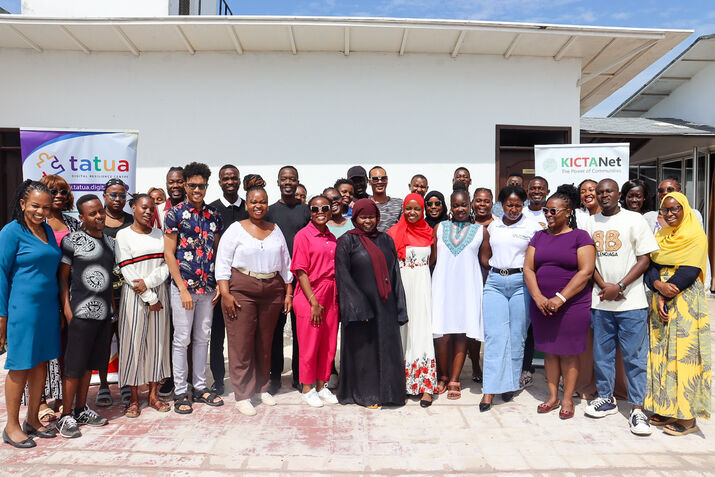
KICTANet, through funding from GIZ and with support from the Tatua Digital Resilience Centre, conducted in-person training in Mombasa focused on data protection and cyber hygiene practices for vulnerable groups. The capacity-building initiative brought together over 40 participants—including women, journalists, and human rights defenders—to understand key concepts around digital safety.
During the workshop, speakers shared how perpetrators of Tech Facilitated Gender Based Violence (TFGVB can hide behind anonymity and amplify their harm through digital platforms.
The term “TFGBV” has become more widely used than “online violence against women” or “online gender-based violence,” offering a broader definition. According to UN Women, TFGBV includes acts committed, assisted, aggravated, or amplified through technology. This makes it harder to pin down because the perpetrator can be anonymous, and the damage often extends beyond the digital realm.
As one speaker noted, “TFGBV doesn’t always start online—it can begin offline and escalate digitally, where technology becomes the tool for harm.”
When Platforms Amplify Harm
Social media platforms amplify harm differently depending on their nature. As noted in the discussion, the same users behave differently across Instagram, TikTok, and X (formerly Twitter). An innocent comment on Instagram might resurface in a more hostile environment on X, where the tone is often more aggressive.
These digital shifts can worsen the experience of online abuse, especially when screenshots or posts go viral, attracting mass ridicule or threats.“There is a need to research how the same individuals display different personas on different platforms,” a participant humorously suggested, “because the X version of someone is not the same as the Instagram version.”
The workshop offered insights into the psychological, legal, and technological dimensions of TFGBV. For instance, images shared in confidence can be misused, and offensive or pornographic content can be forced upon users without consent—an offense under Kenya’s Computer Misuse and Cybercrimes Act.
Laws, Rights, and Remedies
Yusuf Momanyi, an officer from the Office of the Data Protection Commissioner (ODPC), simplified key legal frameworks governing data protection. He emphasized that the Data Protection Act protects individuals (not companies) as data subjects and sets out rights, responsibilities, and penalties.
“Your data is sacred. It’s more valuable than gold or rubies today,” he said, noting that fines for violations can run into millions of shillings or lead to enforcement notices.Participants learned how to identify data controllers and processors and file complaints in violation cases.
Valerie Waswa, Legal Fellow at KICTANet, walked the audience through regulations, highlighting the need for simplified and localized versions for easier public understanding. She emphasized, “It is only after you know the law that you can speak up and say, ‘This is not right. I will report it.”
Building Safe Digital Spaces in Mombasa
Cherie Oyier, Gender Programmes Officer at KICTANet, welcomed participants and emphasized the need to empower vulnerable communities.
“We are here to equip communities with knowledge and tools for digital safety,” Cherie said in her welcome remarks, setting the tone for a day filled with practical learning.
Neno Newa facilitated a powerful session on cyber hygiene, providing best practices for staying safe online. He emphasized: “We must create digital spaces where vulnerability doesn’t become a target but a call for protection.”
The Way Forward
As conversations around TFGBV deepen, it’s essential to continue building awareness and local capacity. AT KICTANet we are committed to scaling digital rights education. Future collaborations will focus on localizing laws, increasing reporting, and ensuring safe, inclusive online spaces for all.
It was such an interactive session. Learned, unlearned and re-learned alot;moving forward,I will definitely know how to protect my personal data,having a good and strong password for my devices and also how to recognize phising.
Good job to KICTANet and the whole team who facilitated.
Good work!