
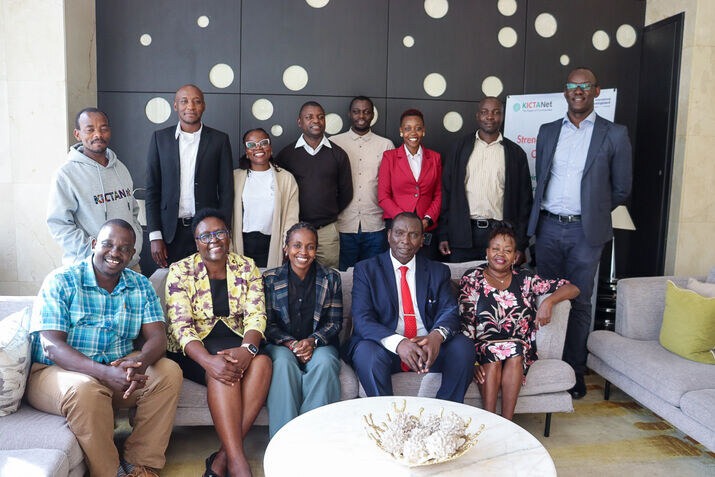
The Strengthening Digital Communities (SDC) project, led by KICTANet and partners, was designed to revolutionise “Food Poor” counties in Kenya by enhancing digital inclusivity, ensuring universal access to digital resources and technology, and fostering socio-economic empowerment among marginalised groups.
The project’s ultimate goal was to improve income, livelihoods, food security, well-being, and community health.
Launched in September 2024, the SDC project prioritised women, girls, youth, persons with disabilities (PWDs), farmers, and small-scale traders in Busia and Mandera counties, aimed to bridge the digital divide through community-driven technology adoption.
Reflecting on the project’s achievements, Dr Grace Githaiga CEO of KICTANet during the project close out meeting remarked:
“The project tested us and allowed us to engage mashinani and expand KICTANet’s capacity building pillar. We are now recognised as key players in digital skilling for marginalized communities. The need remains real, and we look forward to it.”
The project’s tiered training model—master trainers training Community Digital Champions (CDCs), who then trained citizens—proved an effective model for scaling digital literacy.
In total, 17,250 Community Digital Champions (CDCs) were enrolled. Of these, 10,739 completed the Information and Communication Technology Authority (ICTA) basic digital skills course, 1,336 earned ICTA Smart Academy certification, and 4,377 received training in digital services for entrepreneurship and agripreneurship.
Notably, 1,848 persons with disabilities were trained. CDCs played a crucial role in reaching over 600,000 citizens—515,649 in Busia and 84,351 in Mandera—empowering them with foundational digital skills and increasing their confidence and proficiency in using technology.
The impact of the project was transformative. “We were able to contribute to economic empowerment; CDCs and citizens/SMEs expanded their incomes. The inclusion aspect for women and girls in Mandera and Busia was significant,” said Victor Kapiyo, KICTANet Project Lead.
Harriet Ratemo, Training Co-ordinator added, “The course was accessible, especially to women and girls, making them more proactive in the digital space and providing continued mentorship.”
The SDC project also delivered tangible economic benefits. A total of 6,556 youth were found, reporting an average income increase of 35.07%, with 31.5% experiencing income growth.
CDCs themselves saw income increases of 28%. Sote Hub enabled 73 MSMEs to establish an online presence, while Plusfarm trained 100 entrepreneurs who successfully launched agribusiness ventures.
The project facilitated access to digital technology, including the delivery of 150 computers to Mandera County, and provided internet bundles through partnerships with Safaricom, though challenges such as electricity shortages and connectivity issues persisted.
In addressing trust and resilience, the project focused on Technology-Facilitated Gender-Based Violence (TFGBV).
Cherie Oyier, KICTANet’s Programs Officer for the Women’s Digital Rights Program explained, “We enhanced the capacity of women and girls to use online platforms, bridging digital gaps and supporting economic empowerment. Women and girls became more vocal online, and this also contributed to economic empowerment”.
The project documented 607 gender-based violence cases in an online tracker and trained 127 security and health officials in Busia and Mandera counties.
The SDC project also contributed to national policy and research, developing four AI policy documents, awarding 10 AI challenge fund projects, and supporting the finalisation and publication of Kenya’s AI Strategy.
All milestones and indicators of success were achieved as planned. Key achievements included the development of a training curriculum and portal, recruitment of 72 trainers, training of 17,210 CDCs, and certification of 1,336 CDCs under the ICTA Smart Academy. Partners met or exceeded targets for digital employability and entrepreneurship training, and the project established robust partnerships.
The main change to the project design was the delivery of 150 computers to Mandera County in January 2025.
The success of the SDC project was supported by strong political will from the county governments of Busia and Mandera, the Ministry of ICT and the Digital Economy, and the ICT Authority, as well as the dedication of downstream partners and an active citizenry eager to learn.
The Strengthening Digital Communities project led by KICTANet with support from the UK Government’s Digital Access Programme through the British High Commission in Nairobi, in collaboration with:
Government Partners: The Ministry of Information Communication and Digital Economy, The Ministry of Agriculture and Livestock Development, The Ministry of Youth Affairs, Creative Economy and Sports, County governments of Busia and Mandera, The Information and Communication Technology (ICT) Authority, The National Council for Persons with Disabilities, The Kenya Society for the Blind, The Kenya Bureau of Standards (Kebs), and the Kenya Agricultural Livestock and Research Organization.
Non-State Partners: Technology For Growth (TECH4G), African Centre for Technology Studies (ACTS), Generation for Change and Development (GENCAD), African Centre for Women, Information and Communications Technology (ACWICT), EldoHub, Sote Hub, UK-Kenya Tech Hub, Plusfarm, Akukuranut Development Trust and Kilimo Hakika.
The project is part of a broader effort to transform digital communities in Kenya, aligning with the UK Digital Development Strategy (DDS) 2024-2030 and Kenya’s Bottom-Up Economic Transformation Agenda (BETA). , aims to improve digital skills and access in the country.
Charles Juma, UK-AID’s Country Lead and Advisor for the Digital Access Programme, praised KICTANet’s efforts: “The British High Commission should be co-opted into other KICTANet projects, we would be delighted to collaborate.”
In summary, the SDC project had a transformative impact on Busia and Mandera counties, significantly advancing digital literacy, economic empowerment, and digital inclusivity among marginalized groups.
As Dr. Grace Githaiga concluded, “The need remains real. We look forward to building on these successes and continuing to empower marginalized communities.”