
By Cherie Oyier
“I do not agree with what you have to say, but I will defend to the death your right to say it.”~Voltaire.
This quote, that is associated with Voltaire, has been the bedrock upon which the right to freedom of expression is anchored and it formed the opening discussion during this year’s Summer School on Misinformation, Disinformation and Hate Speech offered by UNICRI (United Nations Interregional Crime and Justice Research Institute) and SIOI (Società Italiana per l’Organizzazione Internazionale).
Freedom of expression is a fundamental right provided for under Article 19 of the International Covenant on Civil and Political Rights (ICCPR).
However, Article 19 (3) specifically provides that this right carries special duties and responsibilities and hence may be restricted by law or where necessary to protect the rights or reputation of others or for the protection of national security, public health, morals or order.
How technology fuels misinformation and hate speech
With technology advancing, sources of news and information have shifted from traditional TV and radio channels to social media platforms. These platforms support increased volume, velocity and variety of information disseminated at a time. Access to these platforms means that dissemination of information is no longer the preserve of media houses, which are bound by ethical and professional guidelines.
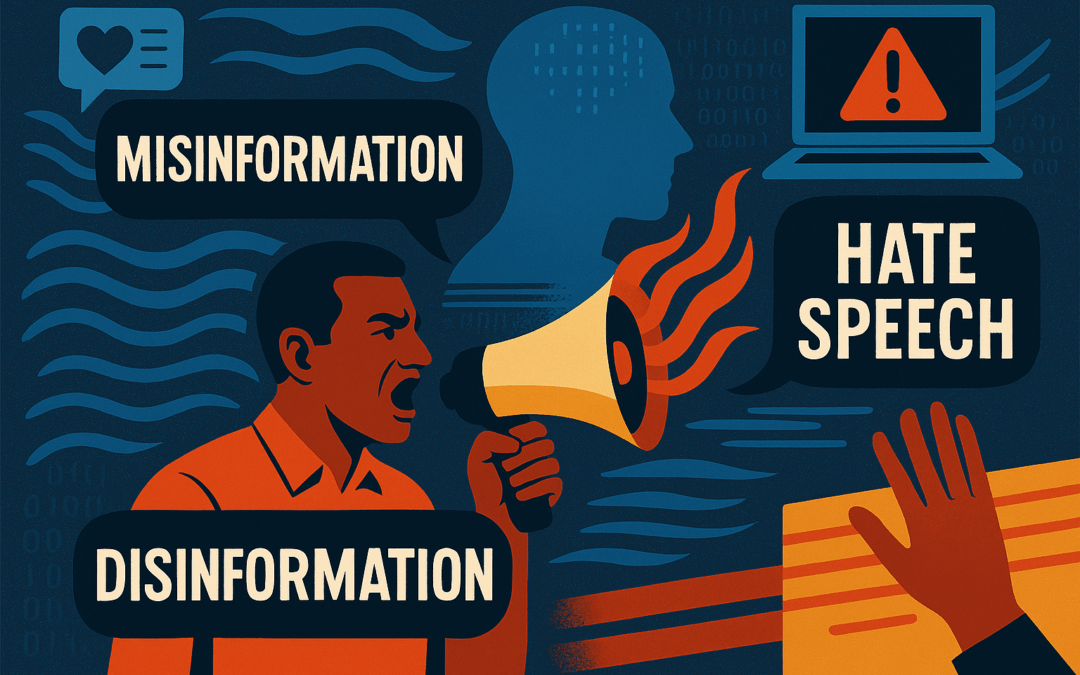
Digital influencers, artificial intelligence, bots and algorithms now can shape narratives and influence the masses by spreading misinformation/disinformation and hate speech without much regulation.
In Kenya, the use of mis/disinformation has played out especially in the political and governance space.
These tactics have been employed by not just the political class but also activists and citizens to counter narratives, distract attention and influence thoughts. Voltaire’s stand on defending to the death what one has to say, even though one might not agree with it, elicits the question of what if whatever is being said is so polarising and bound to cause great harm to society? Should this still be defended?
The short answer to these questions is found in the restrictions placed on the right to freedom of expression under Article 19 (3) of the ICCPR and Article 33 (2) of the Constitution of Kenya 2010.
Challenges in Tackling Mis/Disinformation and Hate Speech in the Digital Era
Countering Mis/disinformation and hate-speech on online platforms is a challenging task based on issues such as anonymity, the sheer number of such posts and jurisdictional limitations. Measures such as content moderation deployed to counter these ills are not short of challenges themselves.
The African region, and the global majority at large, have experienced asymmetrical application of measures to counter mis/disinformation and hate-speech as compared to countries in the global north. From limited resources put towards content moderation to slow and sometimes no action on reports of these vices.
Furthermore, the change of tact by social media platforms such as X towards reliance on community notes further shifts this responsibility from platform owners to users.
Strengthening Defenses: Peer to Peer Fact Checking and Capacity Building
Based on these developments, other measures must be strengthened. During the Summer School on Misinformation, Disinformation and Hate Speech, emphasis was put on peer-to-peer fact-checking.
Peer-to-peer fact-checking is, however, only possible where the capacity of internet users is built on technical skills such as reverse image searches, video and media analysis and source and link verification, among other techniques.
Going Forward: A Shared Responsibility
The role of digital rights activists cannot be underscored, especially now that technology and generative AI continue to impact the development and dissemination of mis/disinformation and hate speech. Their role of holding platform owners accountable must now be complemented with building the capacity of the masses on fact-checking skills as well as documenting incidents.
Further, states including Kenya ought to adopt the UN Global Principles for Information Integrity. This document advances five principles to uphold information integrity, including: societal trust and resilience, healthy incentives, public empowerment, independent, free and pluralistic media and transparency and research.
It makes sector-specific recommendations targeting technology companies, Artificial Intelligence actors, advertisers, private sector actors, news media, researchers, civil society, fact-checking organisations and networks, states, political actors, and the United Nations.
Some of the recommendations include:
- Allocation of sufficient and sustained resources to address sociocultural linguistic contexts and languages of operation by technology companies.
- Consistent application of resources by technology companies towards content moderation processes across all areas of operation.
- Uphold fair working conditions for content moderators by technology companies.
- Investment in media and information literacy for personnel and players in the information sector by the private sector.
- Promote open access to ensure free access to information for researchers.
Conclusion
Misinformation, disinformation, and hate speech threaten democratic institutions, public trust, peace, and social cohesion. As emerging technologies accelerate the spread of harmful narratives, a united front—grounded in policy, education, and technical innovation—is essential to uphold information integrity in the digital age.
Cherie Oyier, Programs Officer-Women’s Digital Rights, KICTANet