

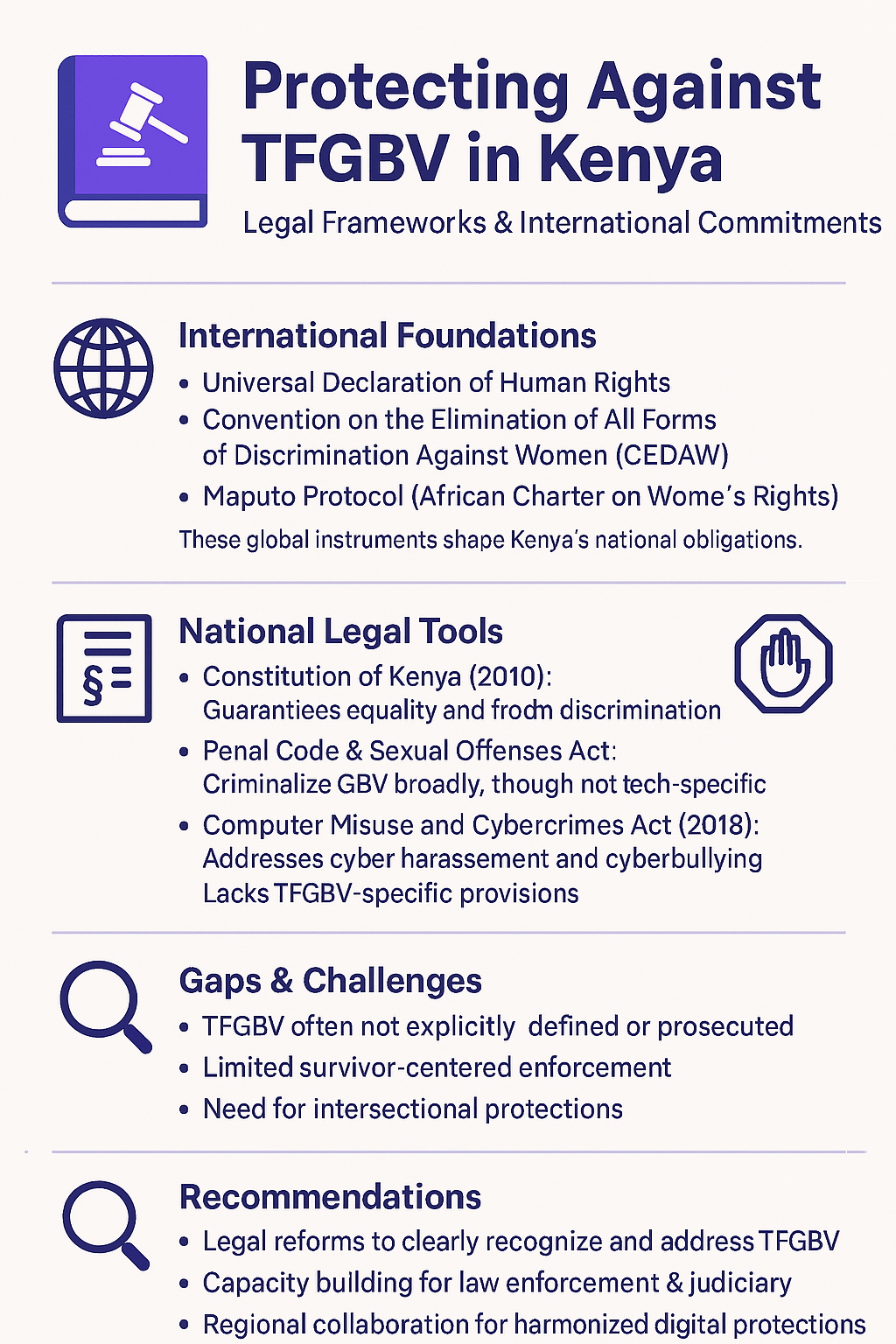
Last week in our series on legal frameworks addressing Technology-Facilitated Gender-Based Violence (TFGBV), we explored the 2010 Constitution of Kenya and its three main categories of protection. Today, we turn to international law, drawing from our recent publication to examine how Kenya’s constitutional safeguards are reinforced and extended by the treaties to which Kenya is a party at both the regional and international levels.
While there can be scepticism about the effectiveness of international legal protections, it is important to recall that Kenya’s Constitution expressly recognises such laws as binding. Articles 2(5) and 2(6) establish that general rules of international law and all ratified treaties are automatically part of Kenyan law. This means that the rights and duties set out in international instruments are directly relevant to the fight against TFGBV and form a critical part of Kenya’s legal landscape.
i) International Covenant on Civil and Political Rights (CCPR)
One of the foundational instruments, the ICCPR, recognises the inherent right to life and human dignity for all. It upholds freedoms from torture, cruel or degrading treatment, slavery, and servitude. The ICCPR also guarantees personal security, equality before the law, recognition of legal status, and strict non-discrimination, including on grounds such as sex. Privacy and the protection of one’s correspondence, honour, and reputation are specifically safeguarded, essential aspects in our increasingly digital world. Notably, the ICCPR entrusts states with a duty to protect children from exploitation and abuse, affirming their special vulnerability and need for protection.
ii) International Covenant on Economic, Social, and Cultural Rights (ICESCR)
Alongside this, the ICESCR broadens protections to cover equal treatment for men and women, as well as the right to safe, healthy working conditions. Children and young people receive protection from economic and social exploitation, ensuring that their well-being is not placed at risk. States are expected to proactively realise these rights and prevent any unjustified rollback of protections.
iii) African Charter on Human and Peoples’ Rights
On the regional front, the African Charter on Human and Peoples’ Rights adopts an even more ambitious approach. It affirms that all people, without discrimination, are entitled to Charter rights. Core rights such as equality before the law, protection of life and integrity, dignity, and personal security are prominently featured.
The Charter is explicit in its demands for the elimination of discrimination against women, and it mandates special protection for groups at heightened risk, including women, children, persons with disabilities, and the elderly.
iv) Convention on the Rights of the Child (CRC)
When it comes to children, specialised treaties underscore their further rights and protections. The CRC lays out principles of non-discrimination and the child’s best interests, and secures rights to life, privacy, and protection from all forms of abuse—including sexual exploitation and trafficking. Children with disabilities are guaranteed special care, while all children are protected from economic exploitation and harmful practices. The CRC further emphasizes the need for prompt recovery and reintegration for victims of abuse.
v) The African Charter on the Rights and Welfare of the Child (ACRWC)
The ACRWC mirrors these principles while tailoring them to the African context. It upholds non-discrimination, prioritises the best interests of the child, and extends protections against harmful cultural and social practices. Children’s rights to life, survival, development, and dignity are closely guarded. The ACRWC also insists on special support for children with disabilities and comprehensive safeguards against violence, exploitation, and trafficking.
Next week, we’ll continue our series by exploring the specialised international treaties that Kenya has ratified, as detailed in Chapter Two of our report. Stay tuned for an in-depth look at how these targeted instruments further strengthen protections against TFGBV in Kenya.