
Kenya’s journey in digital governance is defined by a critical question: how do we effectively regulate without stifling innovation or infringing on fundamental rights? This delicate balance is central to the ongoing dialogue between government bodies, civil society organizations (CSOs), Big Tech, and content creators. Finding a middle ground between regulation and a hands-off approach has proven to be a persistent challenge.
This complex issue was a key focus at the recent Social Media 4 Peace (SM4P Phase II) and Kenya Safe and Inclusive Space (KenSafeSpace) in collaboration with KICTANet, Internews, UNESCO, and the Communications Authority of Kenya (CA). The discussions, led by experts in governance, offered crucial insights into the interplay of advocacy, regulation, and inclusivity in shaping Kenya’s digital future.
Historically, as provided by Dr. Grace Githaiga, CEO of KICTANet, Kenya’s multi-stakeholder internet governance model has been in place since the 2006 ICT Policy. To move beyond this, strong, evidence-based advocacy is crucial in navigating the Internet’s ever-changing landscape.
“Strong advocacy means learning from global spaces, translating lessons locally, and ensuring no stakeholder is left behind,”

Participants during the joint KenSafeSpace/SM4P Phase II workshop in Mombasa
Further, it is important to note that Kenya’s success depends on our ability, as a country, to adapt global best practices to local realities while ensuring that all voices are heard.
With the dynamic nature of regulation, Rosemary Mwangi of the Communications Authority of Kenya (CA) emphasized that in a world of rapid technological advancement, regulatory frameworks must be adaptive and not rigid.
Ms RoseMary likened the process to a household, where platforms, just like children, must adjust to evolving rules.
This analogy stressed the fundamental principle: fostering a safer and more stable online environment is a shared responsibility. Regulators have the mandate to develop flexible, forward-looking policies, while platforms bear the obligation of proactively building accountability and compliance into their systems.

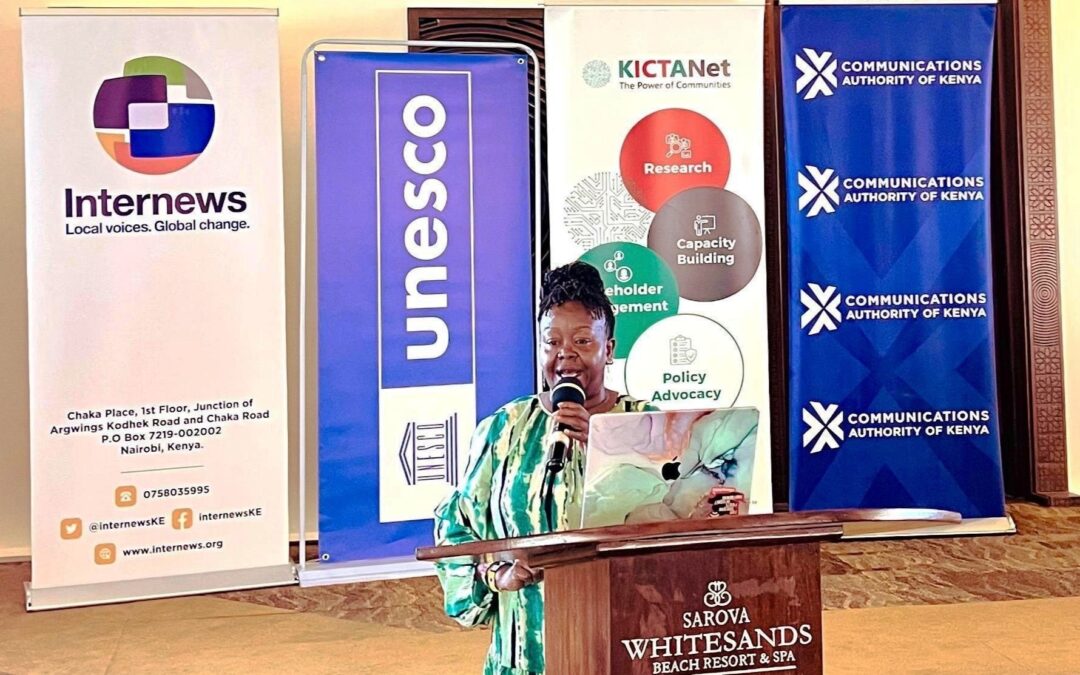
Rosemary Mwangi during the joint KenSafeSpace/SM4P Phase II workshop in Mombasa
Crucially, this model views the user not as a passive consumer but as an active participant, whose role in promoting digital citizenship is vital to the ecosystem’s health. Ultimately, the future of digital governance in Kenya rests on this collaborative effort, ensuring that all stakeholders contribute to an environment that is both secure and inclusive.
Other pressing challenges that need collective approaches include the risk of regulatory overreach that could threaten civic spaces, the need for clear accountability mechanisms for tech platforms, and persistent gaps in citizen engagement within policy-making processes.
However, despite these challenges, we need to be forward-looking and focus on opportunities to co-create digital policies that prioritize inclusivity, human rights, and innovation. Similarly, evidence-based research is essential for helping policymakers strike a delicate balance between necessary regulation and the preservation of digital freedoms.
We cannot forget the vital role of independent media in holding institutions accountable and amplifying diverse voices. And Jacob Nyongesa of the Media Council of Kenya would not agree further by insisting that without a robust media and civil society to act as watchdogs, regulatory processes risk becoming opaque and unresponsive to public needs.

Rosemary Mwangi Jacob Nyongesa during the joint KenSafeSpace/SM4P Phase II workshop in Mombasa
In conclusion, we all need to agree that adaptive regulatory frameworks must evolve with technology but remain anchored in human rights principles. A fine line that requires continuous, multi-stakeholder dialogue involving government agencies, CSOs, the private sector, and the everyday internet user.
Vallary Lukhanyu is the Public Relations and Communications Officer at the Bloggers Association of Kenya (BAKE). She has a background in strategic communication, stakeholder engagement, and advocacy campaigns. Her work focuses on building inclusive Internet and digital spaces in Kenya, and beyond.