
Have you ever pondered the question, “What’s the purpose of a revolution if we can’t dance in it?” At its heart, this phrase captures the essence of our struggles: the quest for a better quality of life.
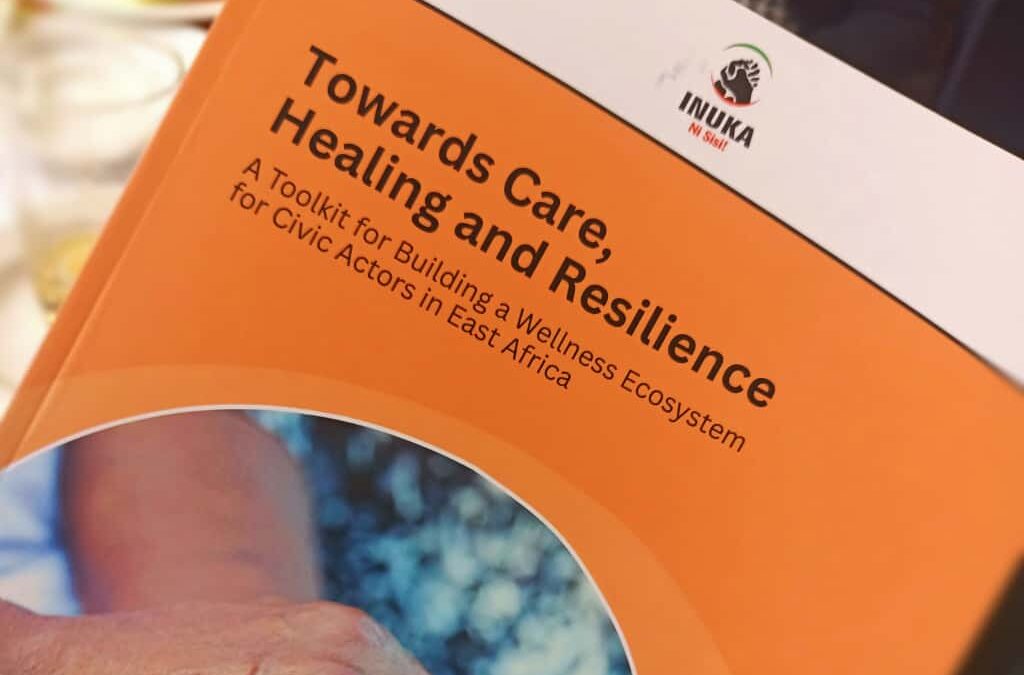
On the 15th of October, 2025, we experienced a groundbreaking moment with the launch of the “Towards Care, Healing, and Resilience Toolkit” by Inuka Ni Sisi, in collaboration with the Legal and Human Rights Centre in Tanzania and the Uganda National NGO Forum. But what can we expect from this toolkit?
Firstly, this thoughtfully designed and timely toolkit emphasizes that organizational wellness is not merely an afterthought; it is a fundamental cornerstone of the vibrant work done by Civil Society Organizations (CSOs)and human rights advocates. It offers practical strategies and resources that empower organizations to improve their internal structures, promote employee well-being, and ultimately create a more effective and sustainable impact on the communities they serve.
In recognizing the interconnectedness of organizational health and the success of their missions, CSOs and human rights advocates can embark on a journey toward stronger, more vibrant organizations that are better equipped to address the challenges they face in today’s complex social landscape.
Historically, the well-being of activists and human rights defenders has been deeply neglected. This challenge was exemplified by past difficulties in acquiring resources for the essential work of debriefing and psychosocial support for staff who routinely absorbed the trauma of survivors. A formal vocabulary and mechanisms for funding internal care were often found wanting. The toolkit directly addresses this historical omission by providing actionable frameworks to counter the profound stressors currently faced by the sector, including:
- The Burden of Vicarious Trauma: Studies cited within the toolkit underscore that human rights defenders carry trauma levels comparable to those of first responders or veterans. This startling reality is now being acknowledged and given the proper tools for clinical and systemic response.
- Isolation and Digital Strain: In the post-COVID-19 working environment, where isolation and blurred boundaries have been created, a new layer of vulnerability is being dealt with. The toolkit provides resources that enable the assessment and management of individual and organizational needs, ensuring that work environments are safe and supportive.
- Lack of Organizational Commitment: In the past, self-care was often viewed as a personal responsibility, and organizational systems were not designed to embed wellness. The toolkit now ensures that a culture of care will be integrated into the organizational DNA of civil society actors.
Secondly, this resource is being positioned as a crucial element in sustaining civic action amid a difficult global context. The principles that ground the toolkit—including Do No Harm, a focus on the survivor, and a trauma-informed approach—ensure that care is delivered ethically and effectively. Furthermore, an ecological framework is adopted, showing that individual healing serves as the necessary foundation for healing within the organization, family, community, and the broader movement.
Dancing in the Revolution
Thirdly, the purpose of this work is not simply survival; it is to enable activists to carry out their mandate with wholeness and joy. It has been wisely stated, “You hurt others when you’re hurting,” indicating that trauma carried by activists will inevitably be inflicted on others.
“What is the point of a revolution if we can’t dance in it?”
The advocacy and defense of human rights is arduous work; however, if the movement itself is defined by exhaustion, trauma, and burnout, the victory will be hollow. Joy and sustainable well-being are being redefined as essential indicators of a successful, liberated society.
When activists are well, they are better able to bring their “whole selves to work,” thereby deepening their ability to connect, empathize, and sustain the struggle over the long term. Thus, the ability to “dance”—to find joy, peace, and resilience—is not a distraction from CSOs’ work, but is understood as the ultimate act of CSOs’ warfare itself.
As a multi-stakeholder platform committed to a robust civic space, KICTANet has consistently and always aligned with the spirit and objective of this wellness toolkit. Our extensive work in the civil society space, particularly in advocating for digital rights and strengthening CSOs’ capacity to engage in policy, demonstrates an understanding that an effective movement must be a resilient one.
For example, KICTANet’s active support for initiatives that place Civil Society Organisations at the centre of digital policy and our development of local capacity-building programs show a direct investment in the sustainability of civic action. We empower actors to tackle challenges like disinformation and online safety – in the belief that effective advocacy is only possible when the sector is healthy and well-resourced.
Lastly, as an organization, we root for the widespread adoption of the “Towards Care, Healing, and Resilience Toolkit” by all civil society members and human rights activists. A resilient civil society, one where well-being is embedded as a core value, is considered the most capable force for driving necessary societal change.