
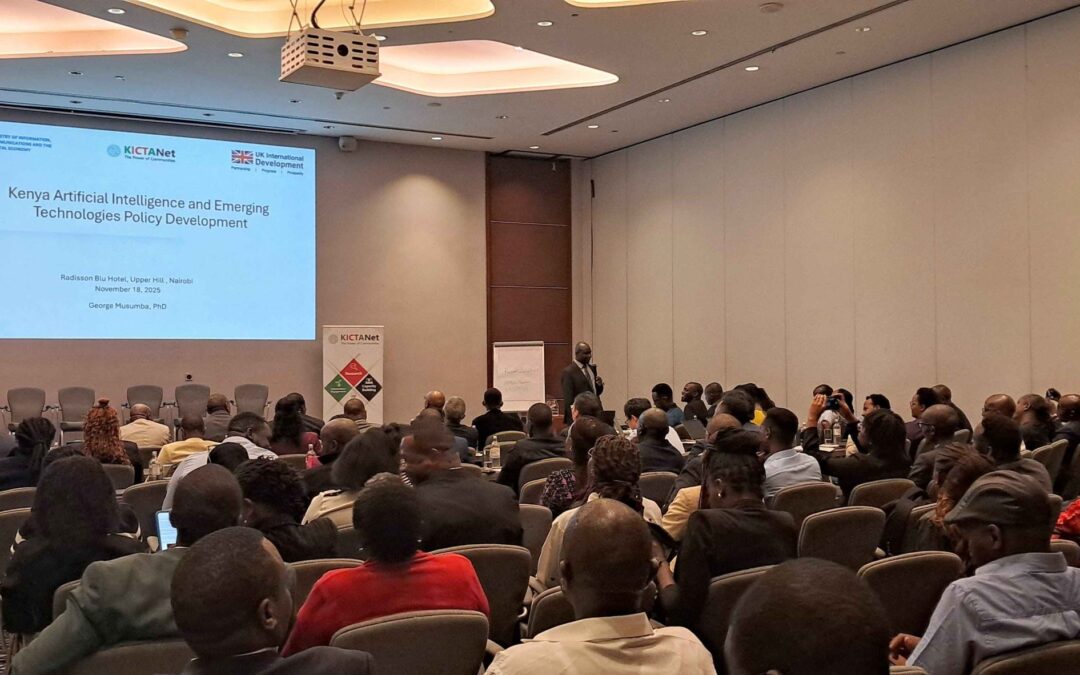
The Government of Kenya, through the Ministry of Information, Communications and the Digital Economy (MICDE), has officially launched the development of the Kenya National Artificial Intelligence (AI) and Emerging Technologies Policy.
The development of the Kenya AI and Emerging Technologies Policy is a collaborative effort led by MICDE in partnership with the Kenya ICT Action Network (KICTANet) and a multi-stakeholder Technical Working Group (TWG). The TWG brings together representatives from government ministries and agencies, county governments, academia, research institutions, the private sector, civil society organizations, and global partners ensuring a broad base of ownership and domain-specific expertise throughout the policy co-creation process.
This initiative is designed to be inclusive, context-aware, and aligned with Kenya’s national digital priorities, including the Digital Masterplan (2022–2032), Vision 2030, and the Bottom-Up Economic Transformation Agenda (BETA). MICDE provides strategic leadership and coordination, anchoring the AI Policy within the country’s broader digital governance and innovation ecosystem.
The Inception Workshop, held in Nairobi, marked a critical milestone in the country’s commitment to harnessing AI for inclusive, ethical, and transformative digital growth. The workshop convened a diverse group of stakeholders, including government agencies, academia, civil society, private sector leaders, youth innovators, and development partners, to co-create a policy framework that reflects Kenya’s constitutional values and global aspirations.
Kenya’s digital legacy is well established. From the global success of M-PESA to civic tech innovations, the country has consistently demonstrated leadership in digital transformation. But as AI, robotics, blockchain, and quantum computing reshape society, the need for a unified governance framework has become urgent.
“This moment is more than a policy design exercise. It is a defining opportunity for us to shape the digital future of our country,” said Ali Hussein, KICTANet’s Board of Trustees Chairperson. “Whatever happens in this country resonates across the region.”
Strategic Roadmap and Policy Framework
Dr. Gerge Musumba presented the Kenya AI Policy Roadmap 2025, outlining a structured, participatory, and evidence-based methodology. The roadmap identifies key gaps in governance, regulation, and public trust, and proposes a four-pillar foundation:
- Inclusive Co-Creation: Engaging stakeholders across sectors and counties to ensure legitimacy and public trust.
- Evidence-Driven and Globally Aligned: Benchmarking against AU, EU, and OECD standards while grounding in Kenya’s context.
- Rights-Based, Safe, and Trustworthy Governance: Anchoring the framework in constitutional values: dignity, equity, privacy, and justice.
- Adaptive, Innovation-Ready Ecosystem: Enabling agile regulation, ethical innovation, and resilient institutions.
The policy development process will unfold in five phases, from ecosystem mapping and stakeholder consultations to Cabinet validation and national implementation.
UK–Kenya Partnership and Global Collaboration
The AI and Emerging Technologies policy development process is supported and funded by the British High Commission (BHC) in Nairobi, through its governance and digital transformation portfolio. This support is part of the broader UK–Kenya strategic partnership on responsible AI and emerging technologies, reflecting the UK’s commitment to advancing ethical, inclusive, and transparent AI governance frameworks in Africa.
The British High Commission reaffirmed its support through the Digital Access Programme (DAP), highlighting shared priorities in innovation, climate action, and digital inclusion. The UK–Kenya AI Talent Fund, which supported 116 new AI use cases, and Kenya’s first AI Code of Practice were spotlighted as key achievements.
“AI is not just another tech trend; it accelerates our goals around economic growth, resilience, and inclusion,” said the Charles Juma BHC representative on behalf of Ed Barnett, Chargé D’Affairs, British High Commission, Nairobi.
Summary and Next Steps
Dr. Grace Githaiga, Convenor of KICTANet, delivered closing remarks summarizing the day’s achievements and outlining the next steps:
- Consolidation of workshop outputs into a synthesis report
- Sectoral and regional stakeholder consultations
- Drafting and validation of the policy document
- Establishment of a Technical Working Group and sectoral engagement clusters
- Deployment of digital feedback tools and periodic policy briefs
“Let us walk together. Thoughtfully, responsibly, and inclusively toward a policy that serves all Kenyans,” Dr. Githaiga emphasized.
A Call to Action
The workshop reaffirmed Kenya’s leadership in digital innovation and its commitment to ethical AI governance. As Ali Hussein reminded participants, “If you’re not at the table having food with others, you’re probably on the menu. And we don’t want to be on the menu.”
The Ministry of ICT and Digital Economy, in collaboration with KICTANet and the British High Commission, invites all stakeholders to actively participate in shaping Kenya’s AI future.