

Every day in Kenya, survivors of Technology-Facilitated Gender-Based Violence (TFGBV) are turned away from police stations or discouraged from reporting due to a legal system that fails them.
KICTANet’s report, The Existing Legal Framework in Kenya Relating to TFGBV, authored by Dr. Owiso Owiso with assistance from Ivy Kinuthia and edited by Cherie Oyier and Florence Awino, exposes critical flaws—unclear definitions, fragmented laws, and limited investigative capacity—that obstruct justice for victims of online harassment and abuse.
These deficiencies not only embolden perpetrators but also undermine public confidence in the pursuit of digital safety. This article, part of KICTANet’s series of blogs under gender lexicons, underscores the urgent need for reform to create equitable online spaces.
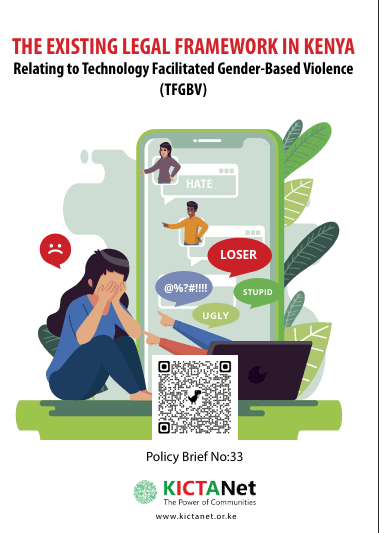
This policy brief, serves as a concise guide to Kenya’s TF GBV-related laws, key findings, and actionable recommendations.
TFGBV is defined as “an act of violence… committed, assisted, or amplified in part or fully by the use of information and communication technologies or digital media, against a person… on… basis of their gender” (United Nations Population Fund, 2020).
Legal Gaps and Their Impact
TFGBV stems from entrenched gender and sexuality stigmas, mirroring offline gender-based violence (GBV), and is worsened by digital anonymity, cyber-misogyny—defined as “hateful behaviour against women on social media”—weak enforcement, and limited awareness.
Women, girls, and LGBTQIA+ individuals face disproportionate harm compared to cisgender heterosexual men, with women under 40 particularly vulnerable. Key issues include:
- Vague Terminology: Terms like “indecent or grossly offensive” in the Computer Misuse and Cybercrimes Act, 2028 create legal ambiguity, impending prosecution of cyber harassment and risking misuse to suppress free speech.
- Undefined Offenses: Lack of standardized definitions for TFGBV acts, such as doxing or non-consensual image sharing, leads to inconsistent remedies and poor survivor support.
- Low Awareness and Fragmentation: Limited public knowledge of TFGBV laws and fragmented legal frameworks confuse survivors about reporting channels. Many law enforcement officers lack familiarity with relevant laws.
- Reporting Obstacles: Stigma, especially when TFGBV coincides with other GBV or privacy violations, deter reporting. Non-trauma-sensitive responses, such as victim-blaming or advising survivors to “simply delete their social media” or “go offline,” further discourage action. Remote police stations often lack technical capacity, referring survivors elsewhere or dismissing cases.
- Evidence Difficulties: TFGBV evidence is often scarce, easily deleted, or obscured by anonymous perpetrators, complicating prosecution. The high criminal evidentiary standard (“beyond reasonable doubt”) causes many cases to collapse or results in lesser charges.
- Prosecution Challenges: A shortage of specialised prosecutors, primarily in urban centres, and limited TFGBV knowledge among investigators and judges hinder effective charging. High-profile cases overshadow those of “ordinary citizens,” and domestic TFGBV cases are often withdrawn. Judicial officers frequently undervalue TFGBV compared to “traditional” crimes.
A Path to Reform
KICTANet proposes precise reforms to bolster Kenya’s legal framework:
- Clear Definitions: “Amend sections 37 of the Computer Misuse and Cybercrimes Act and section 181(1) of the Penal Code to provide clear, concise, circumscribed, and legally-defensible definitions… guarding against misapplication of the law to suppress legitimate freedom of expression.”
- Unified Laws: Harmonize FT GBV-related laws for gender-sensitive, survivor-centered approaches.
- Specific Offenses: Legislate clear definitions for cyberstalking, image-based abuse, and other TFGBV acts.
- Improved Investigations: Enhance law enforcement’s technical capacity to manage digital evidence and streamline investigations.
- Community Support: Bolster grassroots initiatives, like women’s chamaas, as safe spaces for mental health support.
Why KICTANet Leads This Effort
KICTANet’s gender initiatives confront Kenya’s stark digital inequalities with targeted, evidence-based strategies.
Technology-Facilitated Gender-Based Violence (TFGBV), coupled with low digital literacy and cybersecurity gaps, severely restricts women’s access to online economic opportunities, perpetuating systemic exclusion.
Through data-driven advocacy, KICTANet employs tools like the TFGBV tracker to map prevalence and inform policy, aiming to “amplify the voices of structurally silenced women.”
Additionally, their skill-building efforts, including the Tatua Digital Resilience Centre and e-learning modules, empower women with digital security training and equip them to combat online abuse, fostering safer and more equitable digital spaces.
KICTANet’s research demands inclusive, robust policy-making. As urged, “Review all existing laws and policies relevant to TFGBV to ensure they are harmonious, gender-sensitive, and survivor-centred.”
Policymakers must focus on:
- Legal Precision: Define TFGBV offences clearly to enable effective prosecution.
- Inclusive Protections: Safeguard high-risk groups, including LGBTQIA+ individuals and rural women.
- Grassroots Solutions: Fund local efforts which protect children from online abuse.
- Training and Tools: Provide specialised training and resources for law enforcement and prosecutors.
KICTANet extends gratitude to the Foreign, Commonwealth & Development Office (FCDO) through the UK Digital Access Programme for funding this work, and to key respondents for their valuable insights that shaped this publication. KICTANet’s efforts bridge digital rights and gender justice, calling for decisive legislative action to ensure safer, equitable online spaces for all Kenyans.